Ballot Issue 7A, Question by Question
What the Colorado Connector sales tax would fund, what it would cost, and what happens if it fails
I started my morning the way I usually do, catching up on the news, and landed on Colorado Public Radio's guide to Ballot Measure 7A.[1] It covered the basics well: what the measure is, what it aims to do, and what supporters and opponents are saying. But the deeper I read, and the more of its sources I clicked through, the more questions I had. How much of a $295-million-a-year tax actually goes to trains? Didn't Colorado already pay for a train to Boulder twenty years ago? And what happens to a tax with no end date once the railroad is built?
Those questions matter, because 7A is not a small decision. If it passes, voters in 29 Front Range cities will have approved a permanent tax to build and run a 190-mile railroad. So I worked through it the way I would a project at work: seven questions, each building on the last, from what the measure does to what happens if it fails. I can't cover everything, and for the complete picture you should go to the Colorado Connector team's Delivery Plan and Financing Plan, where most of this comes from.[2,3] But if you have fifteen minutes before you fill out your ballot, this should give you what you need to make the call yourself.
1. What is the central aim of the ballot measure?
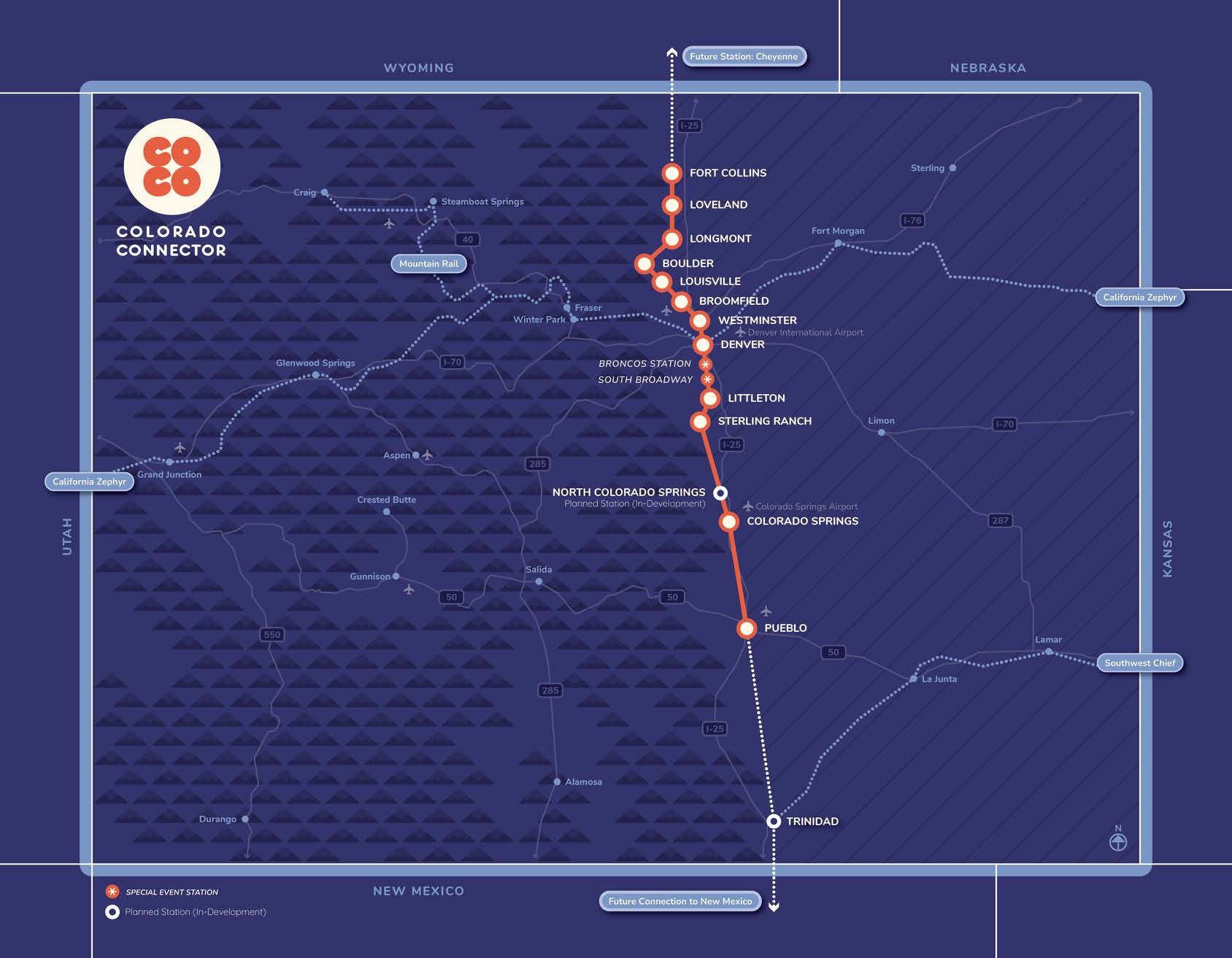
7A asks voters inside the Front Range Passenger Rail District to approve a 0.333% sales and use tax (about 33 cents on a $100 purchase) to finish what the Denver to Fort Collins "Starter Service" begins. The money would pay to extend CoCo south through Littleton, Sterling Ranch and Colorado Springs to Pueblo, and then to keep adding trains over the following two decades.[2,3]
The District's own goal is full Fort Collins to Pueblo service by mid-2032, within five years of the tax taking effect, then growing toward 10 daily round trips north of Denver and 8 south of it by about 2045.[3] The ballot language also lets the District borrow up to $580 million, with total repayment capped at $785 million, and keep all of the revenue as a voter-approved exception to TABOR limits.[1]
One thing that surprised me: the northern Starter Service (three daily round trips between Denver and Fort Collins, targeted for 2029) is already funded without 7A, through state fee revenue and RTD FasTracks money.[2] 7A is the question of whether CoCo stays a single northern line or becomes a 190-mile corridor.
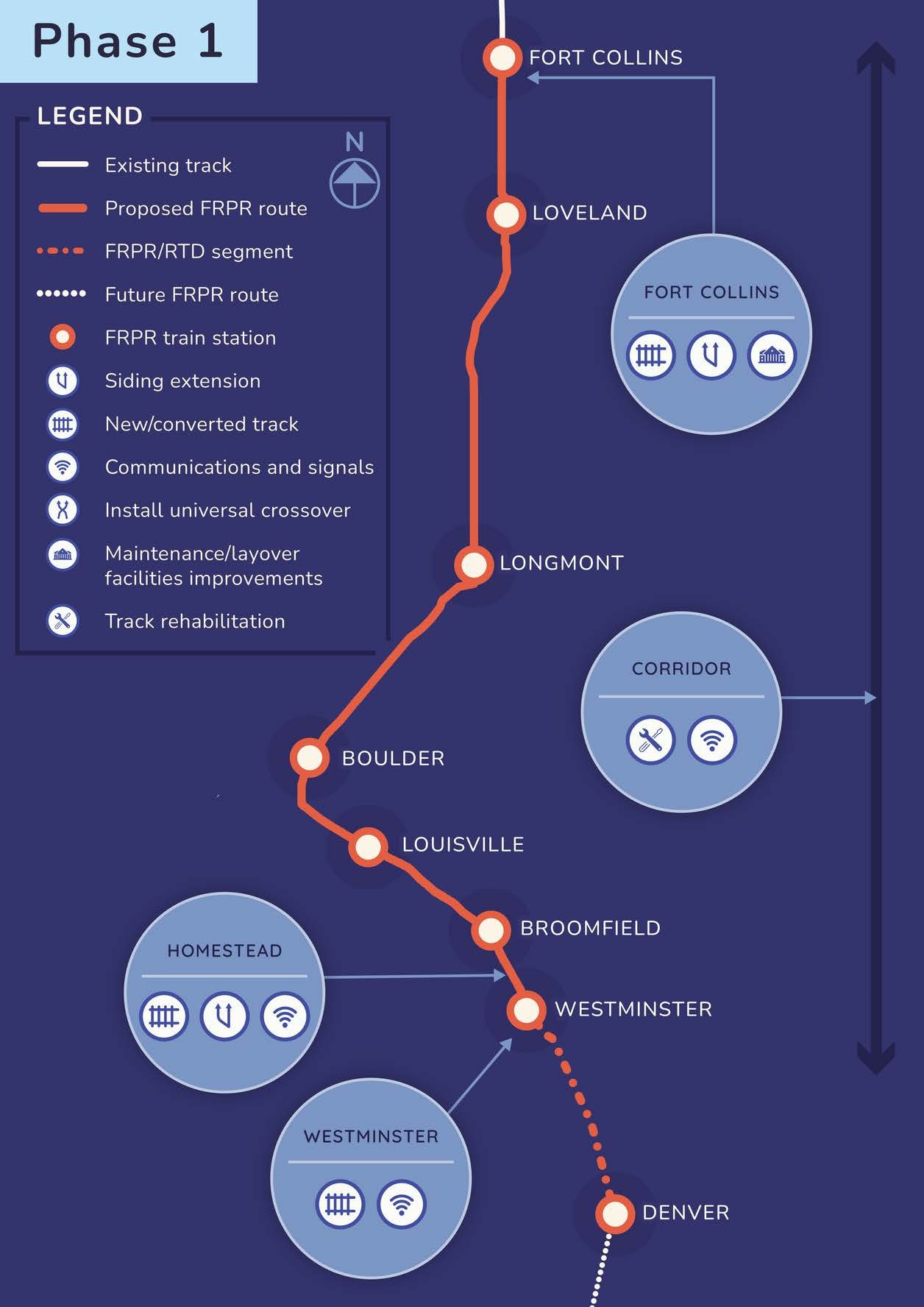
The service would come in phases, each one adding track capacity so more trains can run:[2,3]
- Phase 1, Starter Service (2029): 3 round trips Denver to Fort Collins, 8 stations. $332 million, funded by the state and RTD. No 7A money.
- Phase 2, Full Service (mid-2032 target): 4 round trips north; 2 round trips Denver to Pueblo; new stations at Littleton, Sterling Ranch, North Colorado Springs, Colorado Springs and Pueblo; a new Trinidad station on the Southwest Chief. $1.77 billion.
- Phase 3 (earliest 2037): 6 round trips north, 4 south. $611 million.
- Phases 4 and 5 (earliest mid-2045): 10 round trips north, 8 south. About $2.1 billion combined.
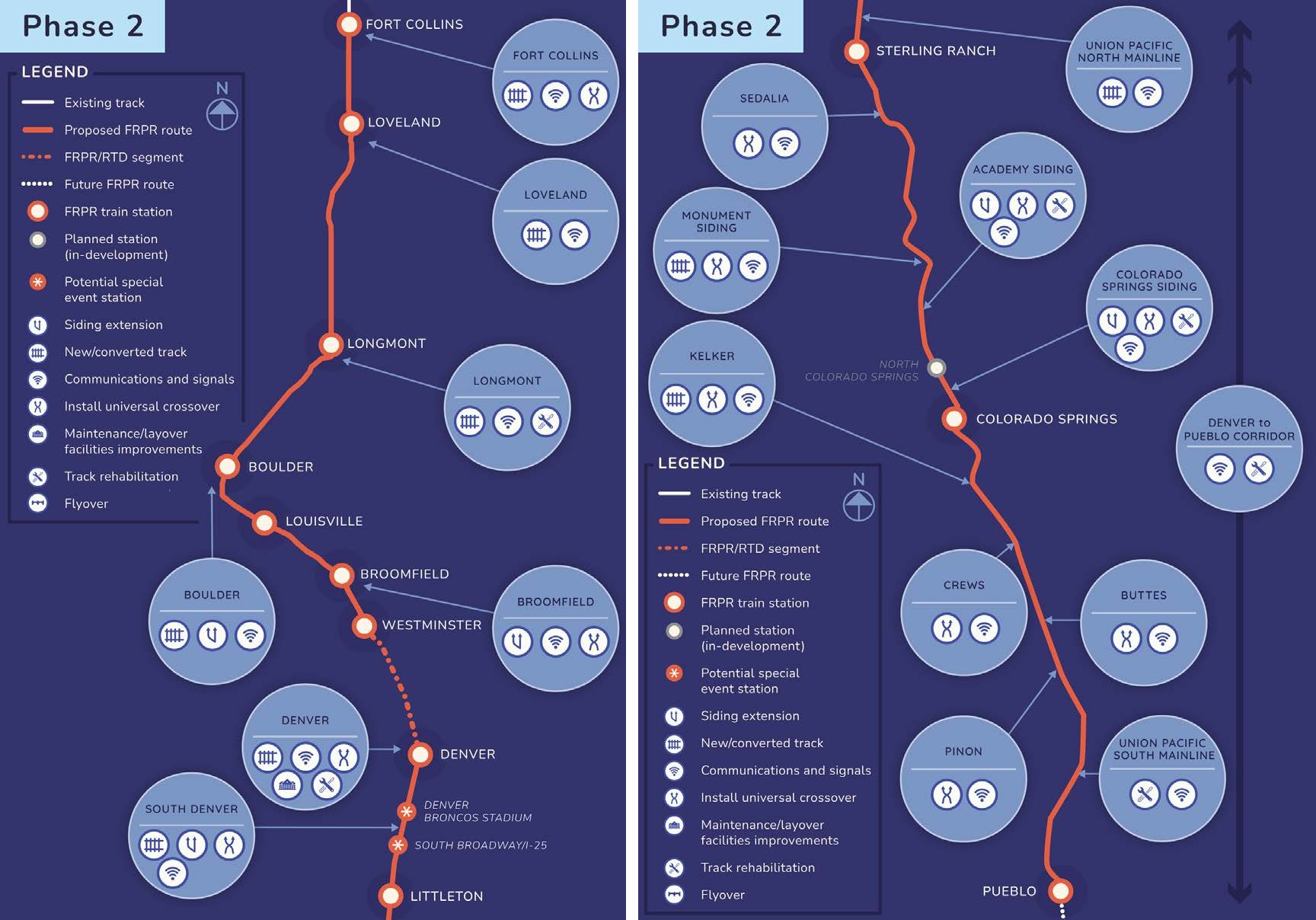

A caveat the District repeats throughout its own plan: everything past Starter Service is "pending ongoing conversations with host railroads." BNSF and Union Pacific own the track, and only the 25-year term sheet for the northern line's three round trips has been agreed so far.[2,4]
2. What are the implications of the sales tax if the measure is approved?
For a household, the math is small: about $3.33 per $1,000 of taxable purchases, or roughly $100 a year for a household spending $30,000 a year on taxable goods (my estimate). Groceries, gasoline, home utilities and prescriptions are exempt.[1]
For the District, it is big. The tax is projected to raise $295 million in its first full year (2028), with collections starting July 2027.[3] That revenue would:
- Fund the $1.77 billion Phase 2 build-out, including about $398 million in bonds issued around 2030 and repaid at roughly $29 million a year for 30 years.[3]
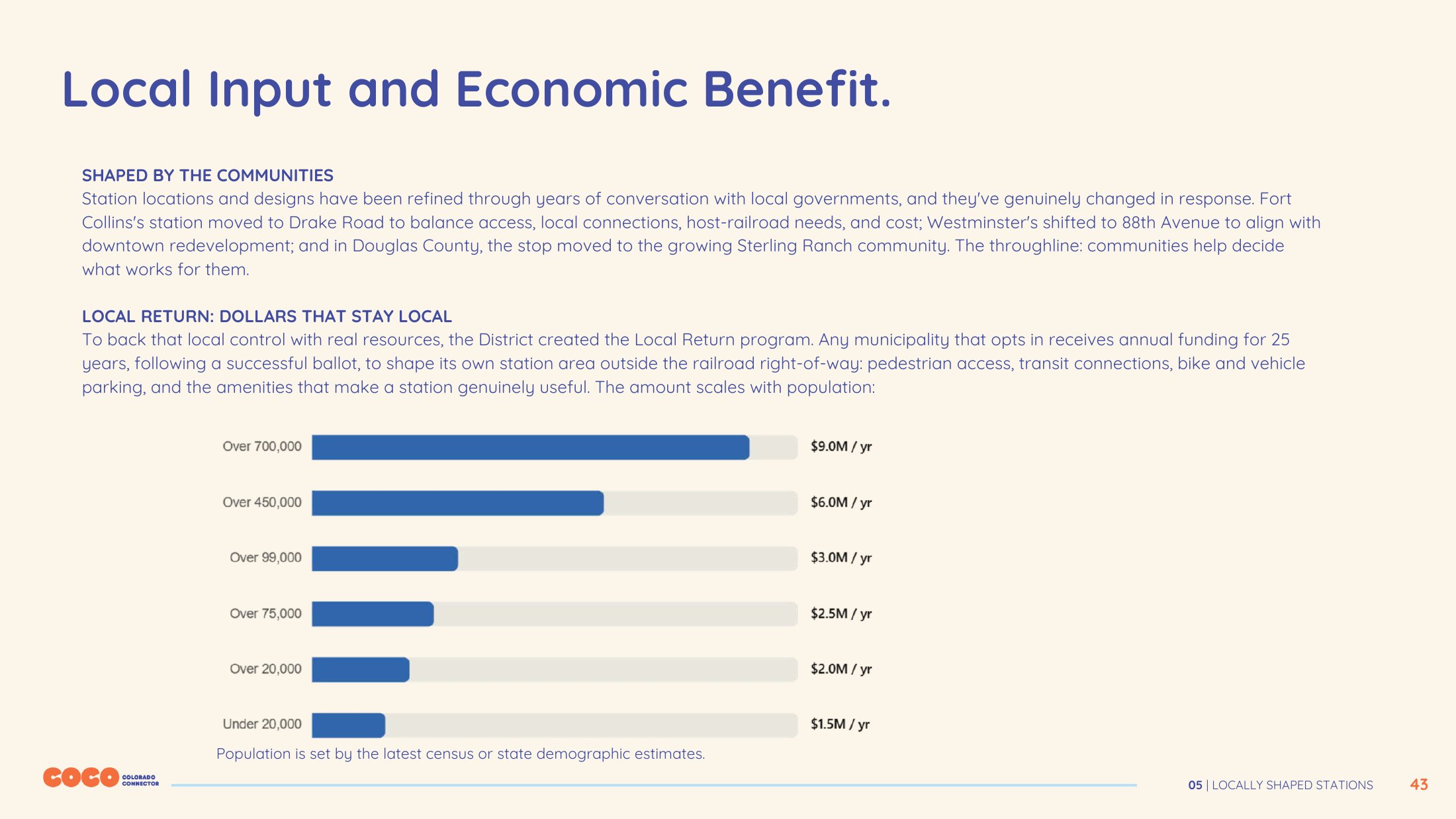
- Send $51.3 million a year for 25 years back to station communities through the opt-in Local Return program, split by population, for sidewalks, bike connections, transit links and station-area amenities.[3]
- Cover Phase 2 and later operating costs, vehicle leases and, after that, pay-as-you-go construction of Phases 3 through 5 (about $2.7 billion more).[2,3]
Who pays and who votes also matters. The District covers 29 municipalities (including Denver, Boulder, Fort Collins, Loveland, Longmont, Colorado Springs, Pueblo and Trinidad) plus the Sterling Ranch metro districts. Unincorporated areas are excluded.[1] Visitors and businesses also pay the tax when they buy taxable goods in those cities. A printing error put 7A on about 800,000 ballots in Adams, Arapahoe, Douglas and Weld counties for voters who live outside the District; officials say only eligible votes will be counted, using tabulation protocols and some hand review.[5]
Finally, Local Return is a real local benefit, but a narrow one. Allocations are by population only, with no equity or income criteria in the District's documents, and the money is for station-area access projects.[3]
3. Why is pursuing a sales tax in this manner a viable funding route?
Mostly because Colorado leaves few other options. Under TABOR, any new tax, tax increase or multi-year debt needs voter approval, and the ballot question must state the first full year's dollar amount (hence "$295 million").[1] When the legislature created the District in 2021 (SB 21-238), it gave it the power to ask voters for a sales tax of up to 0.8%.[2,6] 7A asks for well under half of that ceiling.
Sales tax is also the proven tool for regional transit in Colorado. RTD has been funded mainly by sales tax for decades, including the 0.4% FasTracks increase voters approved in 2004; RTD's total rate is now 1.0%.[7,8] A dedicated sales tax does three things a train project needs:
- It is bondable. A predictable, pledged revenue stream is what lets the District sell 30-year bonds and finish Phase 2 by 2032 instead of waiting to save up.[3]
- It grows with the economy. The plan assumes the taxable base grows 2.5% to 3% a year, so the revenue roughly tracks construction inflation.[3]
- It does not depend on Washington. The Financing Plan assumes no discretionary federal grants or federal loans. Federal money (CoCo is in the second step of the FRA's Corridor ID program) would be upside, not a requirement.[2,3]
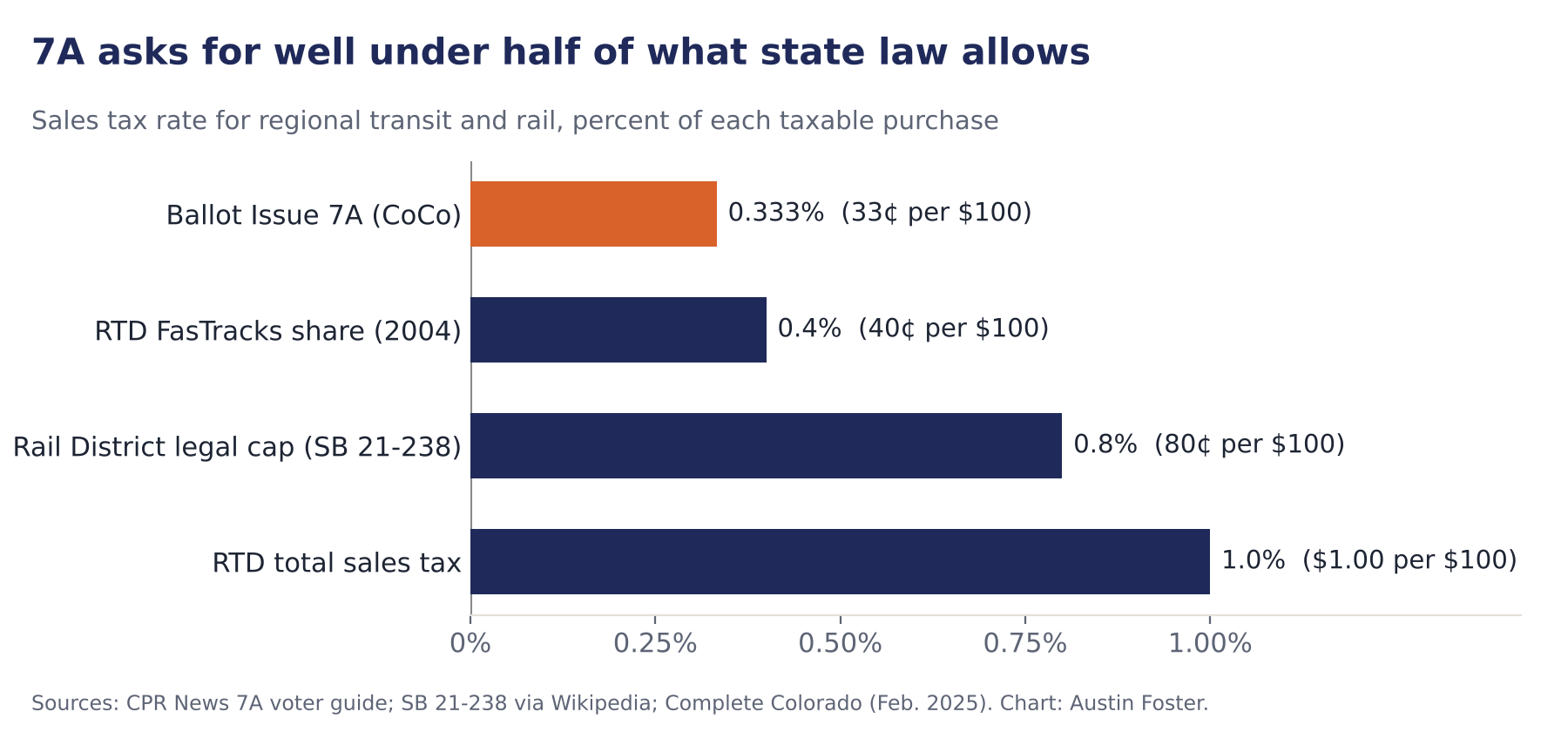
The design of 7A also tries to answer its critics. The District redrew its boundaries so only communities near a permanent station pay and vote.[9] Necessities are exempt.[1] And the plan commits to an annual Financing Plan update reviewed by an independent auditor and a rotating panel of resident taxpayers.[3]
The counterarguments are real, too. Sales taxes fall harder on lower-income households even with exemptions. They swing with recessions (FasTracks' revenue forecast collapsed during the Great Recession).[7] The Common Sense Institute argues that 7A would raise close to 20 times the share of operating costs it directly funds, and that roughly 900,000 District residents live more than five miles from a planned station.[10]
The critique about residents living more than five miles from a proposed station is worth noting. However, because CoCo's stations are major hubs, even residents who live farther than five miles away in places like Denver, Pueblo and Boulder are likely to have local bus service that can get them there. The Delivery Plan notes that nearly every station already sits on a local or regional transit network.[2] Those who own cars can park and use a station like a park-and-ride, but that depends on station design, and under the District's plans, amenities beyond the platform are largely up to each city through Local Return.[2,3] A good question to ask as this gets built out:
I'd also take the "20 times" figure with a grain of salt. It compares the full $295 million a year the tax raises against only the $10 million to $15 million a year of operating cost the tax covers once Phase 2 is running, and it overlooks how expensive it is to build a project of this size.[2,10] Construction is where most of the money goes: about $1.77 billion for Phase 2 and roughly $2.7 billion more for Phases 3 through 5, around $4.5 billion in all (my sum of the Financing Plan's phase totals).[3] The District's own Phase 2 funding graphic makes the split clear:
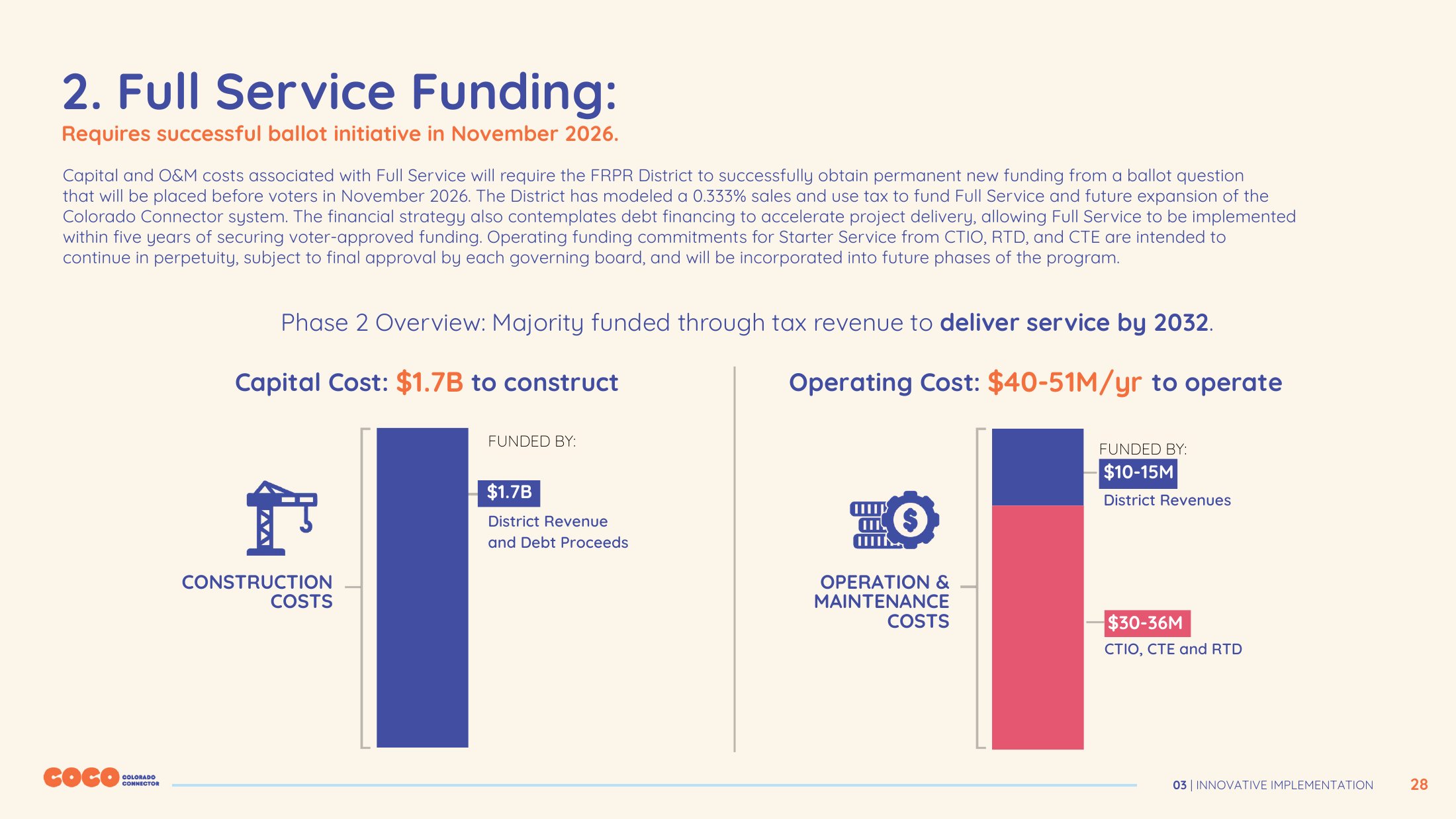
The biggest counterargument, in my view, is the lack of a sunset date. The Financing Plan's forecast runs out to 2060, but the need for new funding seems to run only to about 2045, when the last phase is projected to be complete.[3] The 2060 horizon lines up with the 30-year bonds the plan expects to issue around 2030. For the years after build-out, the plan names only general uses: more stations, service and trainsets, an enhanced Local Return, and possible extensions to Trinidad and toward Wyoming and New Mexico. It publishes no detailed revenue or cost tables for that period.[3]
What happens after 2045? Could the tax be rolled back?
TABOR requires a public vote to raise a tax, not to lower one, so a future District board could in principle reduce the rate without an election.[11] In practice, while bonds are outstanding, the revenue pledged to repay them can't simply be taken away, so meaningful relief is realistic only once that debt is paid off. Neither the ballot question nor the District's plans commit to a rate review or a sunset after build-out. Whether District voters could petition to repeal the tax themselves is something I'd want the District to answer directly. Either way, it is fair to ask the District's board to put its post-2045 intentions on the record before the tax becomes permanent.
4. When was the last time a sales tax like this was implemented in Colorado?
The closest precedent is FasTracks. In November 2004, voters in RTD's eight-county district approved a 0.4% sales and use tax to build a $4.7 billion regional transit network: 119 miles of commuter and light rail and 18 miles of bus rapid transit across nine corridors, promised in roughly 12 years (by 2017).[7,12] One of those corridors was the 41-mile Northwest Rail line from Denver Union Station through Westminster, Broomfield, Louisville and Boulder to Longmont, almost exactly the route CoCo's Starter Service now plans to run.[13]
Was it successful? Did it fall short on its promises?
Both. FasTracks built a lot: the W Line to Golden (2013), the A Line to Denver International Airport (2016), the R Line along I-225 (2017), the G Line (2019), the N Line to Thornton (2020) and extensions to Lone Tree, about 78 miles of new rail in all.[7,12] Union Station became a genuine regional hub.
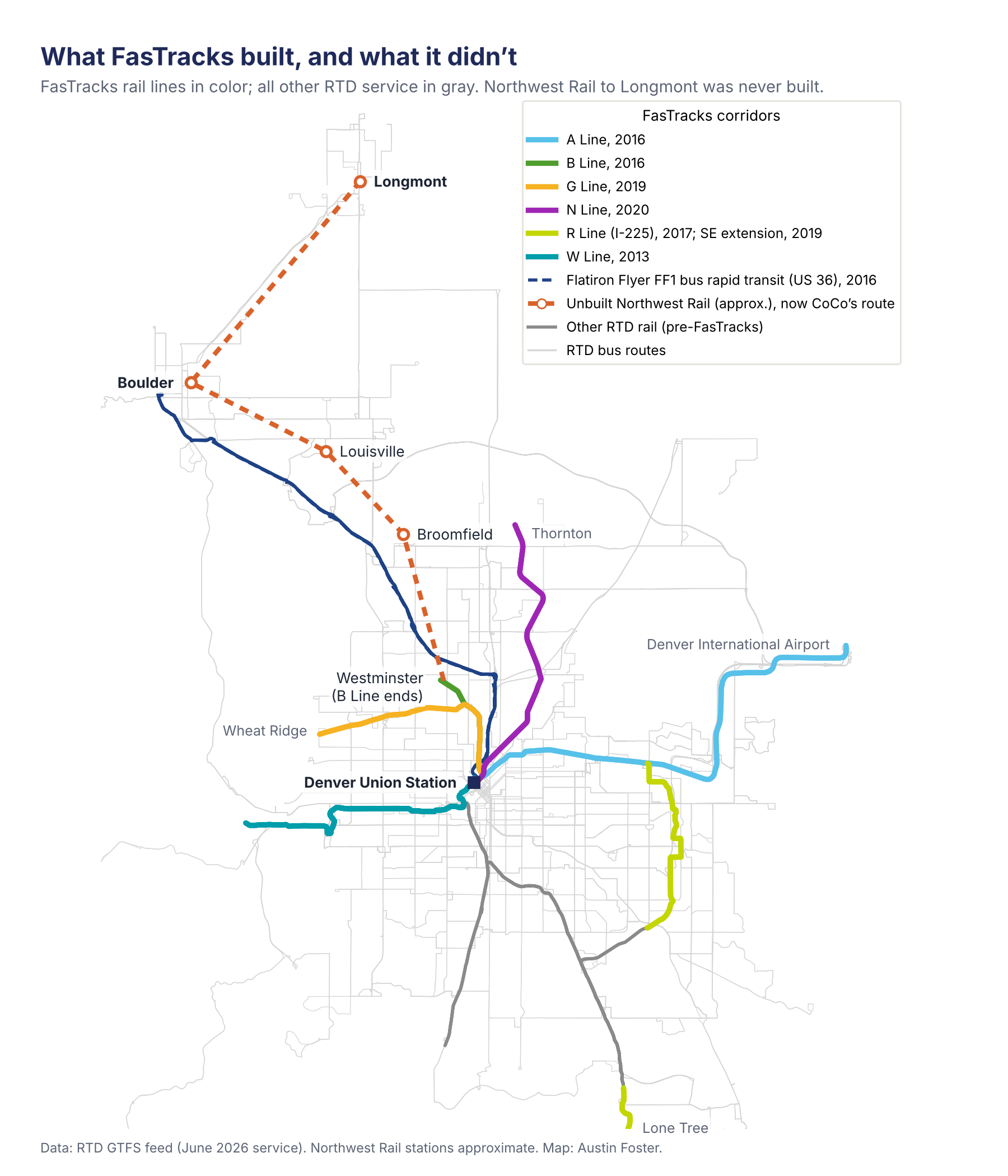
But costs ran away from the plan. The estimate climbed from $4.7 billion to $7.4 billion by 2012, while recession-era revenue forecasts fell.[7,14] In 2011, BNSF asked $535 million for access to its track for Northwest Rail, against the $66 million RTD had budgeted.[4,12] In 2012, RTD's board shelved options to double the tax to 0.8%, saying the timing was wrong.[14] Northwest Rail stopped at Westminster: the 6.2-mile B Line opened in 2016 and averaged fewer than 400 riders a day in 2024.[4,13] In February 2026, RTD's board chair said the full line will never be finished.[7] Boulder and Longmont got the Flatiron Flyer bus instead, part of a $511 million US 36 project that included about $142.5 million of FasTracks tax money.[15]
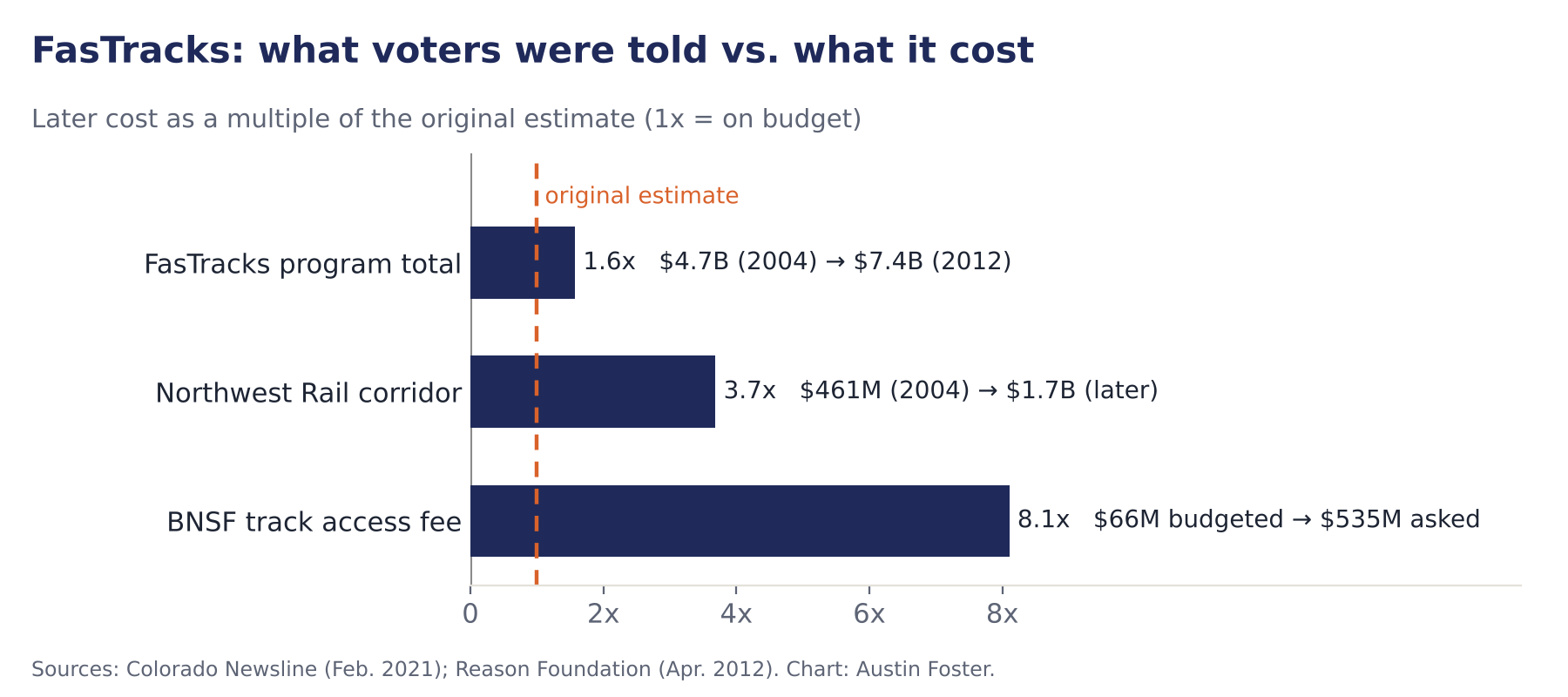
CoCo is, in a real sense, the second attempt at Northwest Rail, and the District frames its plan as learning from that history: a smaller starter project ($332 million instead of an $885 million earlier estimate), a negotiated access term sheet with BNSF before asking voters for money, later phases timed to when revenue is actually available, and annual public updates.[2,3,16] Whether those safeguards hold is the thing to watch.
5. What is the current transit landscape like, and why is securing reliable funding for a service like the Colorado Connector important?
The landscape is split. RTD has lost about 40% of its ridership in recent years and faces a deficit of more than $200 million.[9] At the same time, the regional and intercity routes that overlap CoCo are growing fast. From 2021 to 2025, Bustang's core I-25 service grew about 36% a year and RTD's Flatiron Flyer about 15% a year, more than double the rest of RTD's network. The District notes lines at the Flyer gates at Union Station and full buses on weekday afternoons.[2] In October, the state awarded RTD $44 million from oil and gas fee revenue to add Flatiron Flyer frequency, among other improvements.[17]
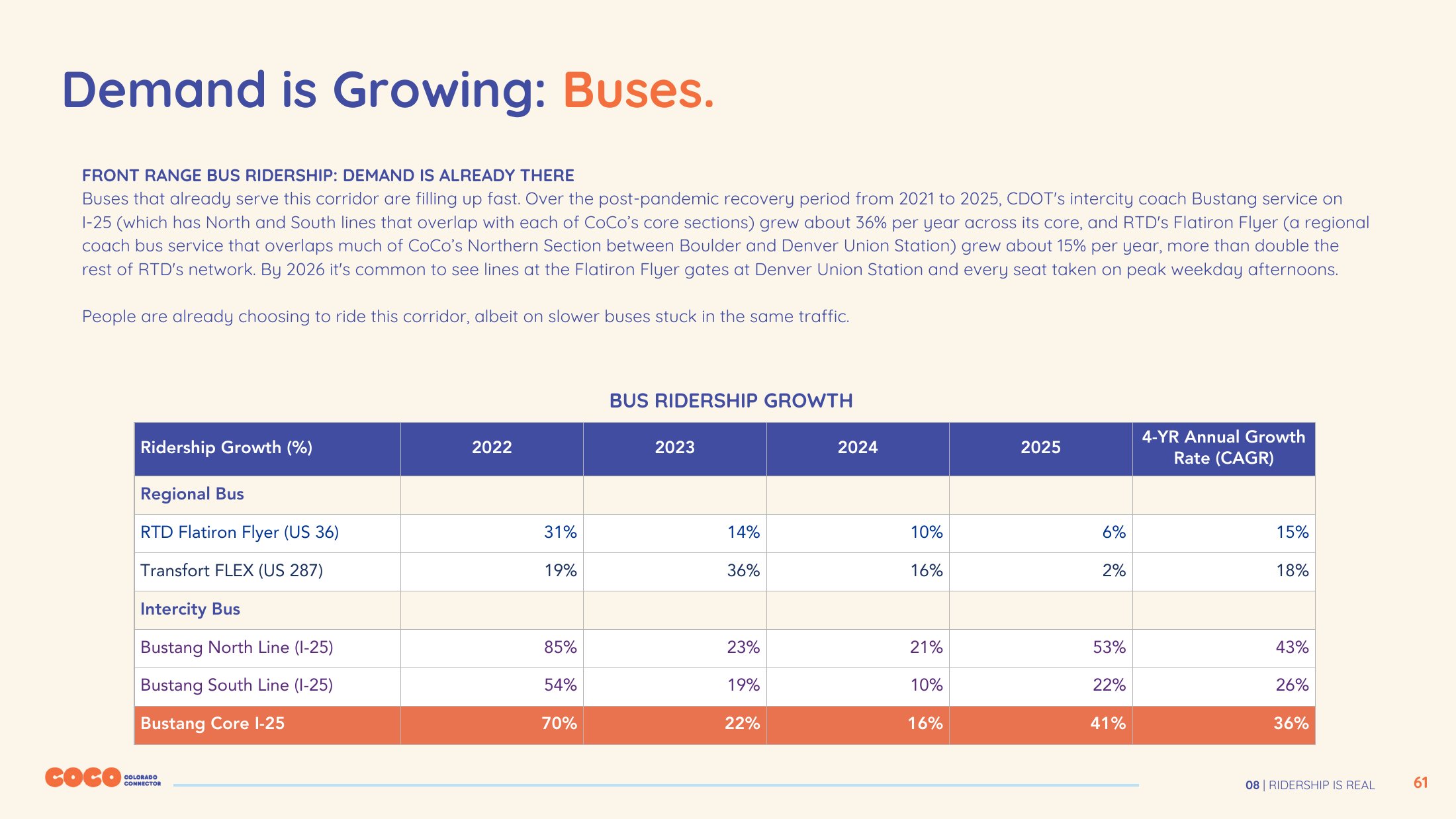
Demand is not the problem; stable money is. Bustang is projected to run a $25.3 million deficit in FY27, growing to about $34.6 million by FY30, and CDOT is considering the same rental car fee (SB 24-184) that pays the state's share of CoCo's Starter Service to help close it.[18] That fee survived a 2-1 federal appeals ruling in July 2026, but further appeals are possible.[19] Starter Service also leans on oil and gas fee revenue (SB 24-230), which rises and falls with production.[3]
Peer systems show why this matters. Minneapolis' Northstar, which ran a few trains a day on BNSF track with no path to grow, closed in January 2026 after its ridership collapsed.[20] Low-frequency service tends to stay low-ridership. A dedicated, voter-approved source is what lets CoCo plan a 20-year path from 3 round trips to 10, sign long-term deals with railroads and an operator, and borrow against future revenue. Without it, service levels depend on whatever the state and RTD can spare each budget cycle.
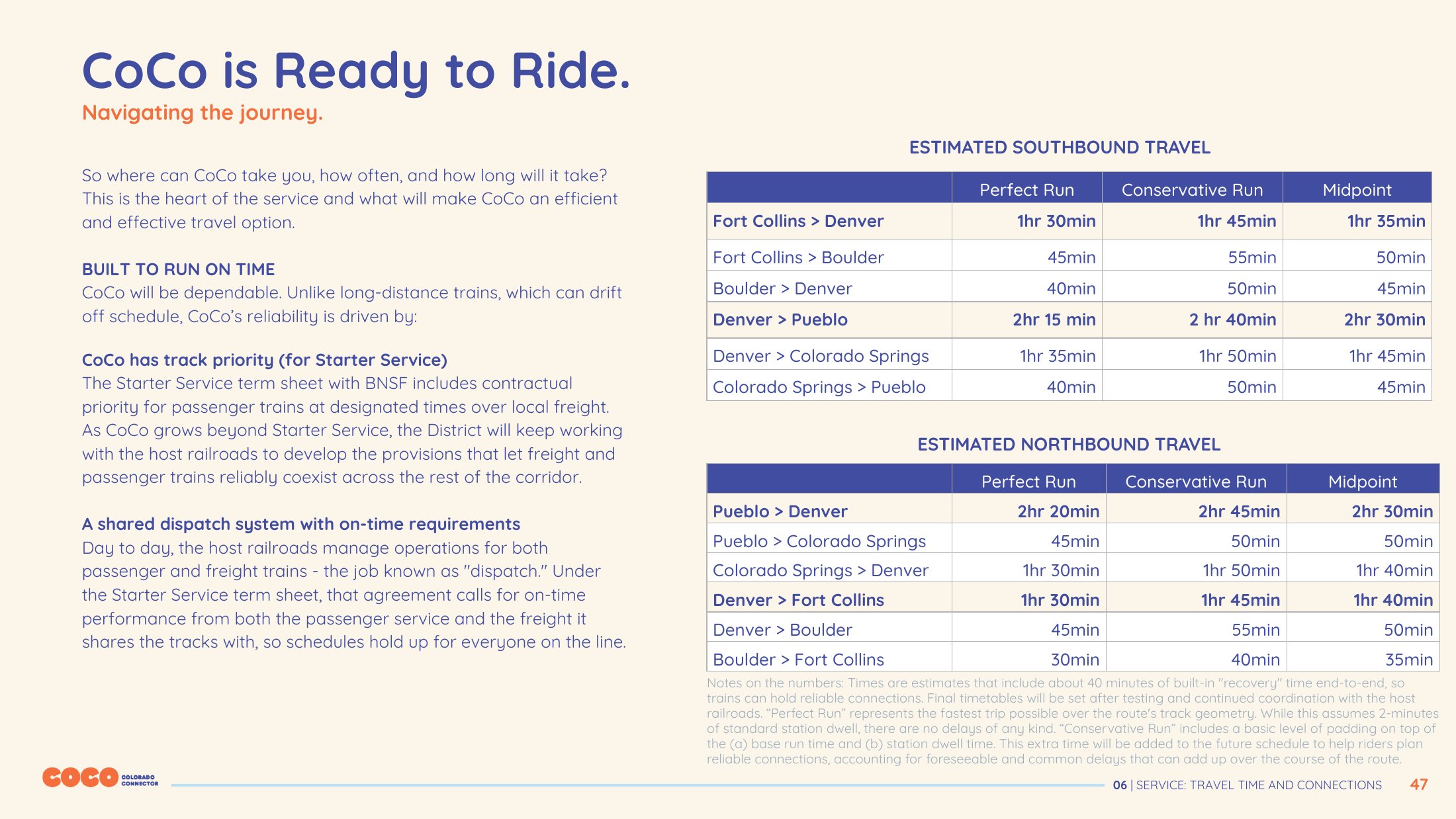
For riders, here is what the District expects the trip to look like:
6. What is the cost of doing nothing?
First, a precise answer: "doing nothing" on 7A does not mean no train. Starter Service is funded either way.[2] What a "no" vote means is no rail south of Denver for the foreseeable future, no path past three daily round trips in the north, and no Local Return money for station areas. Colorado Springs and Pueblo would keep relying on I-25 and Bustang.
What does continued reliance on automobiles and over-capacity bus lines like the Flatiron Flyer do to the residents of Colorado?
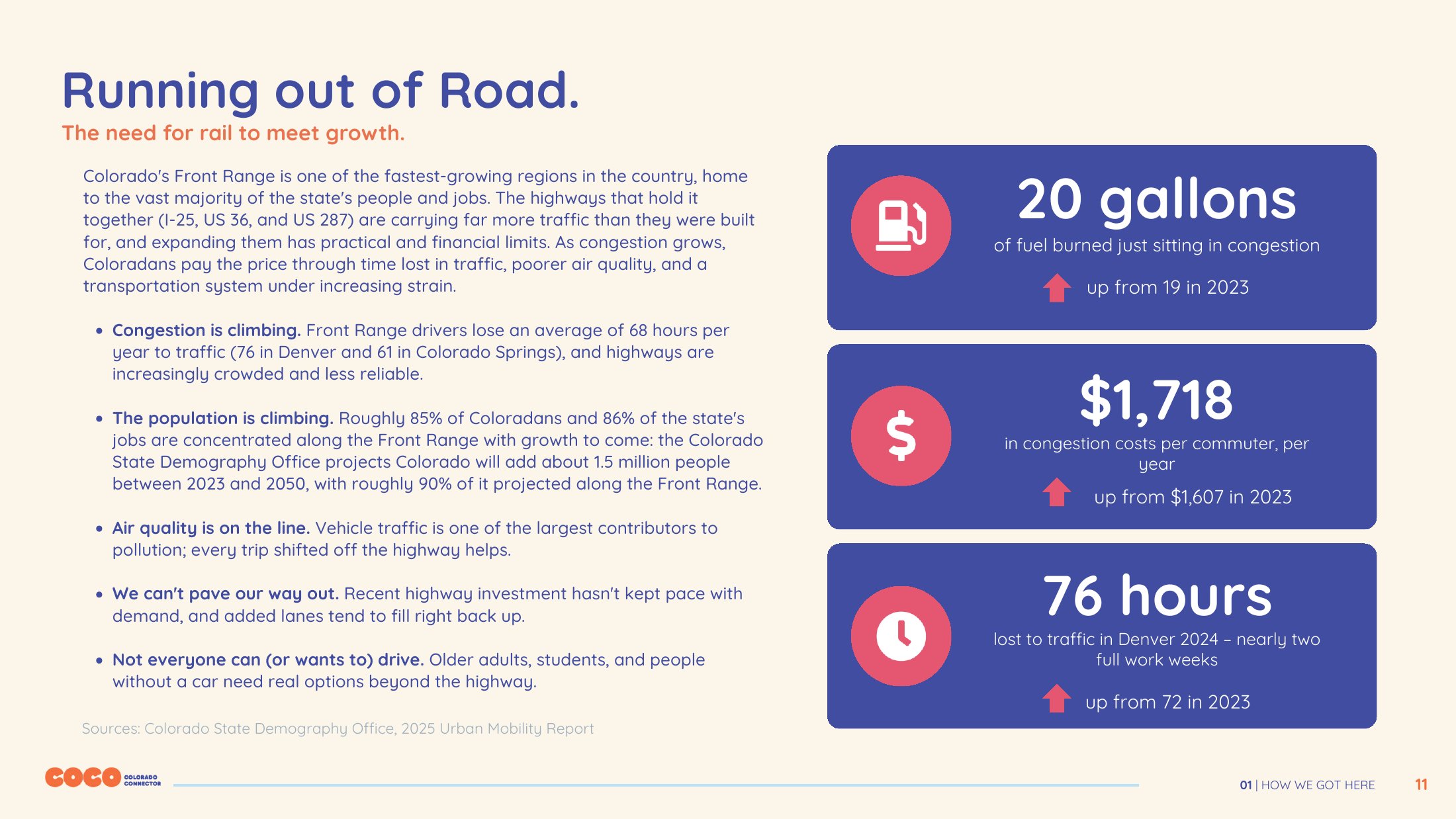
The District's numbers, drawn from the 2025 Urban Mobility Report and the State Demography Office:[2]
- Front Range drivers lose an average of 68 hours a year to traffic (76 in Denver, 61 in Colorado Springs), at a cost of about $1,718 per commuter, both up from 2023.
- About 85% of Coloradans and 86% of the state's jobs are on the Front Range, and the state expects about 1.5 million more residents between 2023 and 2050, roughly 90% of them here.
- The IRS puts the full cost of driving (gas, insurance, maintenance and depreciation) at 76 cents a mile. By the District's math, that makes a one-way Denver to Fort Collins trip about $55 by car, versus about $14 by train at the 19-cents-a-mile fare it is modeling. For someone who already owns a car, the out-of-pocket cost of a single trip is mostly gas, so the gap is smaller than it looks.
For bus riders, crowding is its own cost: buses stuck in the same traffic as cars, standing room on the Flyer at peak, and a growing Bustang network on a deficit.[2,18] At full build-out, the District cites an analysis (SWEEP, 2026) projecting about 233 million fewer miles driven a year and about 126,000 metric tons less CO2, roughly equal to taking 29,000 gas cars off the road.[2]
Honesty requires the other side of the ledger. CoCo will not fix I-25 congestion on its own. Leaders project about 3,500 one-way trips a day at full service, and about 85% of expected trips are discretionary (concerts, family visits, games, recreation) rather than commutes.[2,21] The case for 7A is less "this solves traffic" and more "this gives the Front Range a real alternative to driving for the trips people already make, and a backbone to grow around." Whether that is worth a permanent 0.333% tax is the actual question on the ballot.
7. What should voters watch if 7A passes?
A yes vote is the start of the process, not the end. These are the things I'll be watching:
- The BNSF and Union Pacific deals. The northern term sheet covers three round trips. Ten round trips, and anything south of Denver, still need agreements.[2,4]
- The debt math. The plan's $29 million a year for 30 years (about $870 million, my math) versus the $785 million repayment cap on the ballot.[1,3]
- Life after 2045. What the tax pays for once the build-out is done, since the plan publishes no detailed tables past that point.[3]
- The rental car fee. If it ultimately fell in court, the state's $176 million share of Starter Service would need a new source.[2,19]
- CoCo and Bustang. Whether two state-supported intercity services get coordinated fares and schedules, or compete for the same riders and the same fee revenue.[18]
- Ridership at launch. The District has not published Starter Service ridership projections, and cost per trip depends almost entirely on them.[21]
Before you vote
Ballots are due by 7 p.m. on Tuesday, November 3. If you live in the District, the District's Delivery Plan and Financing Plan are both linked below and both are worth an hour of your time.
Sources
- CPR News, "Ballot Measure 7A: Front Range Passenger Rail District," Sept. 25, 2026. https://www.cpr.org/2026/09/25/vg-2026-ballot-measure-7a-front-range-rail/
- Front Range Passenger Rail District, "Delivery Plan for Colorado Connector (CoCo)," August 31, 2026. https://coloradoconnector.com/wp-content/uploads/2026/08/Delivery-Plan-Colorado-Connector-August-31-2026-Final.pdf
- Front Range Passenger Rail District, "Financing Plan" (working draft), August 2026. https://coloradoconnector.com/wp-content/uploads/2026/08/2026-08-24_FRPRD-Financing-Plan_Clean.pdf
- Colorado Newsline, "Colorado reaches agreement with BNSF for Denver-Fort Collins passenger trains," Apr. 9, 2026. https://coloradonewsline.com/2026/04/09/denver-fort-collins-passenger-trains/
- Colorado Politics, "Election officials settle on fix to 'Coco' train ballot error," Oct. 10, 2026. https://www.coloradopolitics.com/2026/10/10/coco-train-ballot-error-election-solution/
- Wikipedia, "Colorado Connector." https://en.wikipedia.org/wiki/Colorado_Connector
- Wikipedia, "FasTracks." https://en.wikipedia.org/wiki/FasTracks
- Complete Colorado, "$100 million in Longmont tax dollars down the FasTracks drain," Feb. 26, 2025. https://completecolorado.com/2025/02/26/100-million-longmont-tax-dollars-down-fastracks-drain/
- The Colorado Sun, "Front Range rail potential vote on sales tax," July 21, 2026. https://coloradosun.com/2026/07/21/front-range-rail-potential-vote-sales-tax-colorado/
- Rocky Mountain Voice, "7A would raise nearly 20 times CoCo's tax-funded operating costs, CSI says," Oct. 21, 2026. https://rockymountainvoice.com/2026/10/21/7a-would-raise-nearly-20-times-cocos-tax-funded-operating-costs-csi-says/
- Colorado Legislative Council, "TABOR" (overview of the Taxpayer's Bill of Rights). https://content.leg.colorado.gov/content/tabor
- Colorado Newsline, "RTD betrayed taxpayers on FasTracks," Feb. 8, 2021. https://coloradonewsline.com/2021/02/08/rtd-betrayed-taxpayers-on-fastracks/
- Wikipedia, "B Line (RTD)." https://en.wikipedia.org/wiki/B_Line_(RTD)
- Reason Foundation, "RTD abandons FasTracks tax hike," Apr. 25, 2012. https://reason.org/commentary/rtd-abandons-fastracks-tax-hike/
- U.S. DOT Build America Bureau, "US 36 Managed Lanes/BRT Project, Denver, CO." https://www.transportation.gov/buildamerica/projects/project-highlights/us-36-managed-lanes-brt-project-denver-co
- Eno Center for Transportation, "Colorado and BNSF reach tentative deal on passenger rail expansion," 2026. https://enotrans.org/article/colorado-and-bnsf-reach-tentative-deal-on-passenger-rail-expansion/
- CDOT, "$44 Million State Transit Investment to Expand Service on the Flatiron Flyer and Other Transit Services," Oct. 2, 2026. https://www.codot.gov/news/2026/october-2026-news/state-transit-investment-expand-flatiron-flyer-transit-services
- CDOT, "Bustang Transportation Commission Workshop," April 2026. https://www.codot.gov/programs/ctio/assets/agenda-item-documents/2026-agenda-item-documents/april-2026/7c-april-2026-bustang-tc-workshop-pres-accessible.pdf
- Colorado Politics, "Divided 10th Circuit upholds Colorado congestion fee on car rentals," July 27, 2026. https://www.coloradopolitics.com/2026/07/27/divided-10th-circuit-upholds-colorado-congestion-fee-on-car-rentals/
- Wikipedia, "Northstar Line." https://en.wikipedia.org/wiki/Northstar_Line
- Denver Gazette, "What impact could Front Range Passenger Rail have on congestion?" Oct. 7, 2026. https://www.denvergazette.com/2026/10/07/what-impact-could-front-range-passenger-rail-have-on-congestion/
Articles on Matera LLC are explainers that lean on the work of others: public documents, reporting and data, organized and cited so readers can check every claim. Original analysis lives under Analysis.